The Big Move
We Moved. Here's Why That Was Never Just a Real Estate Decision.
We moved offices. It sounds simple until you're the one making the call.
New building, new neighborhood, new way of working. We wanted to pull back the curtain on how we actually decided to move to Oakley, why flexibility beat out every other option on the table, and how we built a space that finally feels like us.
Let's get one thing out of the way first: moving offices is a pain. Anyone who tells you otherwise is lying or has never had to argue about kitchenette placement. But when our old building changed ownership, the universe basically handed us permission to stop saying "we should probably move" and start saying "we're doing this."
So we did.
How we decided
We didn't do this in a boardroom with three people and a spreadsheet. We pulled in the full team and built a dream list: what does our space need to be, and what could it be if we stopped playing it safe? From there, we toured everything. Warehouses. Business parks so polished they felt like a different industry entirely. We got pretty far down the road with a few of them before pulling back.
Here's what killed those options: flexibility is one of the core tenets of how we run Mertz, and none of those spaces had it. We weren't looking for four walls. We were looking for a space that could flex the way we do. Blue Ash was tempting, honestly, but we couldn't find character in our price range. Character won.
Why Oakley
Oakley has what a lot of "professional" office parks don't: a pulse. People walking by. Coffee shops. Food. A neighborhood that has roots and a story, not unlike us. We wanted to stay central in the city, but more than that, we wanted a space where people passing by would actually wonder who we are and want to come find out.
That's the whole point, honestly. We're a creative studio. We didn't want to hide in a business park where nobody sees us. We wanted to be part of a street.
How the team is working differently
The old rhythm had everyone in office on the same couple of days, which meant we had a crowded space some days and an empty one the rest of the week. That's not how we're doing it anymore. The team is spreading out across more days, using the space more consistently, and working the way that actually works for them, whether that's in office or remote.
We didn't just hand this down. We talked to the team constantly leading up to the move and had them tour the space before it was even finished, so buy-in happened before day one, not after. What's come out of that is more intentional gathering. People grouping up, collaborating in person because they want to, not because a policy told them to.
Building the vibe
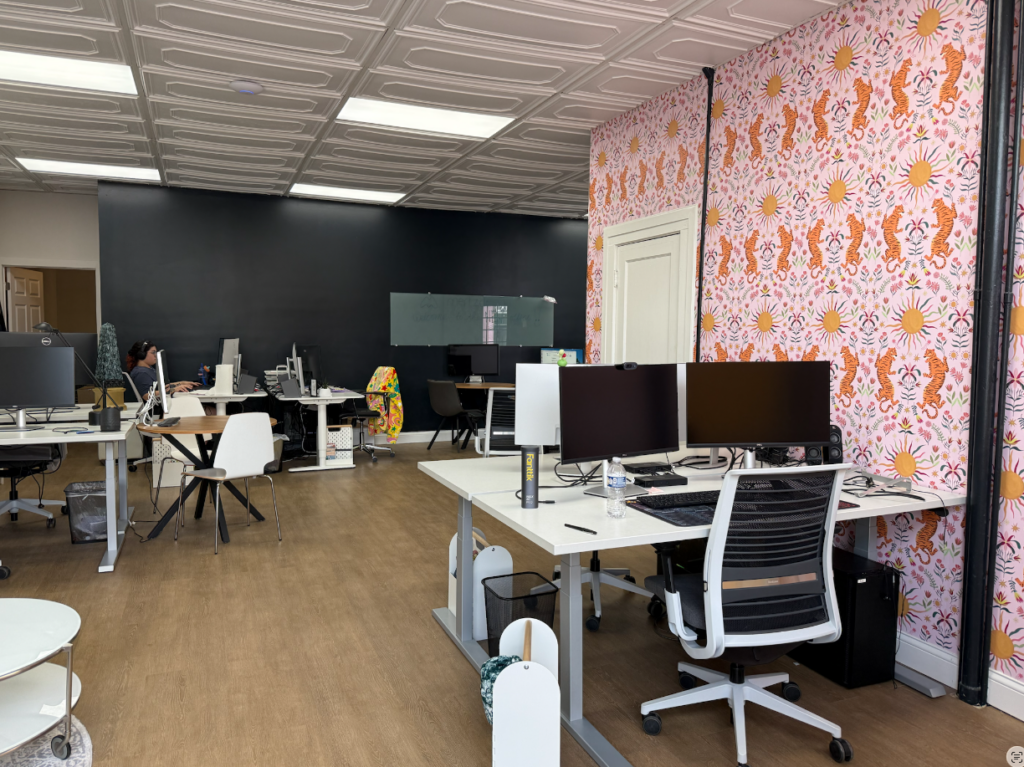
Three words drove every decision in the buildout: fun, energetic, creative. Not words we picked for a mood board. Words we wanted people to feel the second they walked in.
The team built this vision together, and honestly, the floors and the paint did more heavy lifting than we expected. Those two things alone made the space feel like nowhere else. Ceiling demo and bathroom rough-in don't exactly inspire creativity, but the finishes on top of all that unglamorous work are what made it unmistakably ours.
Here's what we hope happens when a client walks through our door: they feel unexpected. They feel like this is going to be a pleasure, not a project. That's the vibe we've always tried to bring to the work we do for our clients, and now we finally have a building that says it before we do.
What we learned
Moving is a hassle. Every founder who has done it will tell you the same thing. But the decisions you make in a move, where to go, what to compromise on, what you refuse to give up, tell you exactly who you are as a company. We learned we're flexible. We learned we want to be seen. And we learned our team will show up for a vision if you let them help build it.
Come see us in Oakley. Grab a coffee first. We'll probably see you walk by.
Kristy Sieve
president